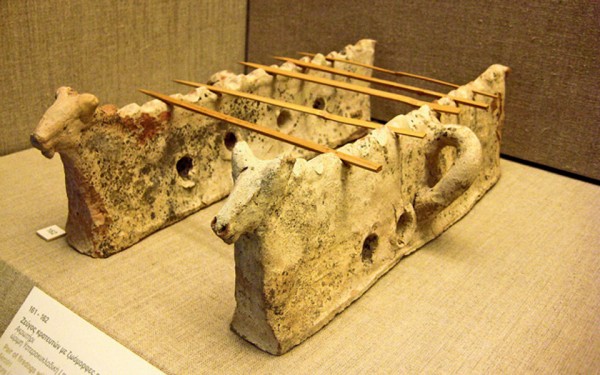


Savvas Tsestos Limnatitis reports on the latest foundings that reveal it was our ancient ancestors that first discovered barbecuing
Oh yes! Souvlaki. Our national treasure. Our pride and joy. The single thing -along with plate smashing of course- that almost monopolises the knowledge of the world’s people about the modern state of our nation. Of our race. Even the magnificence of the Acropolis fails in comparison.
Where did all originate from though? Where are the roots of Greeks love for all things barbecuing spring from? Don’t be in a rush to come up with an answer. Like I was. When I mistakenly presumed that it all started sometime during the Tourkokratia, the Turkish occupation. Alas, I was wrong. In fact I was our ancient ancestors that first came up with the idea. Like most other things really.
The latest findings to come to light from the on-going excavations at Santorini reveal that souvlaki originated in the Aegean almost 6500 years ago! One of the delicacies of the era was the fish garos, a recipe mentioned in the writing of both Sophocles and Platon.
Archaeologist Christos Doumas is in charge of the excavations at Akrotiri, Thera. As he explains, a lot of fruit residues were found in containers that were kept in homes. Residues that were preserved thanks to the falling incinerated ash. ‘These were crop products’ he continues.’ So what we have is knowledge of the cultures of that time. We found fava beans, lentils, krithari- in a jar full of ash- we even found traces of almonds. Also found many stoned crushed olives, so we can talk about oil production. We found a jar with snails, although these were imported! It was Cretan snails’. The excavations also revealed seeds of figs. Which served not only as sugar for the ancients, but also as a form of laxative.
Being an island, obviously traces of fish were also found. These were found in large pots – pitharia- in a dried form along with bones. As they digging got deeper, traces of garon (or garum for the Romans), a type of fish paste that was very popular amongst the aristocrating circles of our neighbours. ‘The aristocracy enjoyed the best part of the fish, while the “plebs” and the army used their heads, tails, fins. We found such a pitharaki and was a breakthrough as it proved that 1500 years before the Romans people at Thera were already making it. It is certainly characteristic of a people who live in and from the sea …”
Our love of meat is well documented. And our ancestors equally loved their meat. During the excavations bones from sheep and goats were found, as well as few small cattle as the islands don’t allow the breeding of big animals. Also a little hunting was found. Rabbits, migratory birds etc. ‘But we found too many residues of sea urchins, clams, cockles and other similar seafood’ the professor continues. As for cooking techniques, what we do know is that the ancients used tripod cooking pots. ‘We also found pans and portable tripod ovens: Fire from above, fire below and pans with lids and small doors. A type of hull with legs ‘. Even skewers were found. But the single thing that surprised him most was the equipment that was found. Where the souvlakia were barbecued. ‘They had notches and holes to circulate the air without turning off the coals. They were very ergonomic. The head at the edge had the shape of a ram. And it ensured healthy cooking, after the fat was falling. “
Which brings us to the message of the story. And the wrong notion that it was the Turks that introduced the art of barbecuing to us. When in fact skewers originated in the Aegean and the Turks did not move into the area until the 15th century. Christos Doumas picks up the story: ‘I once had a conversation with an eminent Turkish archaeologist, the Hellenist Ekrem Akourgkal . And I said that we borrowed a lot from the Turkish cuisine. Bringing as an example the meatball, the keftedes’. The reply from his Turkish counterpart surprised him: ‘You are very naïve. Turks used to me nomads. They didn’t have a cooking tradition of their own. They simply borrowed from the Byzantines’.
Naturally, the excavations at Akrotiri are not the oldest evidence of what the Greeks ate. “No. There are scattered findings from the Neolithic period (5th and 4th millennium BC) in Thessaly, Macedonia, Thrace. But in Akrotiri, thanks to the volcano, we first found so many furled -and so well preserved- evidence. And that is thanks to the volcano. The lavas of Santorini even preserved plants such as palm trees or olive trees dating back 60,000 years. And they reveal a climate that differs from the current one. In early historic times, the 5th, 4th or 3rd millennium BC, people began to cultivate the same wild flora. “
 Hellenic People.Org